
This year marks the 50th anniversary of the Carnation Revolution, a historic coup that unfolded in Portugal on April 25th, 1974. During this momentous event, a group of compassionate captains, employing nonviolent means, successfully dismantled the oldest dictatorship in Western Europe. The successful military uprising brought an end to the Estado Novo, a regime established by Antonio de Oliveira Salazar, who served as prime minister under the guiding principles of "God, Homeland, and Family." Despite outward appearances of democracy, the regime had not held democratic elections since 1925 and imposed various forms of censorship, curtailed freedoms, and enforced repression through its International Police and State Defense (PIDE), which was further bolstered by a network of informants.
The uprising, famously known as the "Carnation Revolution," received crucial support from military personnel who had fought in African territories. These brave individuals were united under the banner of the Armed Forces Movement (MFA), which played a pivotal role in toppling the government of Marcelo Caetano. Caetano had assumed leadership in 1968 after Salazar, who had been incapacitated by an accident. Both leaders were accompanied by Américo Tomás during their presidencies. The military's efforts were bolstered by the solidarity of the people, who rallied under the powerful slogan "O povo unido jamais será vencido" (The united people will never be defeated). Their voices echoed the sentiments of a populace disillusioned with the colonial race in Africa, mired in poverty, weary of state violence and lack of liberties, and fervently seeking social justice that had been suppressed for decades.

People gathered at Carmo Square, Lisbon, on the 25th of April 1974.
The MFA carefully orchestrated the use of specific songs as radio signals to catalyze the revolution. The first song was slated to air on Radio Emmisores Associados in Lisbon at 10:55 p.m. on April 24th. The selected piece was "E depois do adeus" (And after the farewell), composed by Paulo de Carvalho, which had been featured in that year's Eurovision. This song was intended to serve as the initial signal for action. The second song was scheduled to play an hour and a half later. Titled "Grândola Vila Morena" it was the work of José Manuel Cerqueira Afonso dos Santos, better known as Zeca Afonso, a renowned Portuguese singer-songwriter who openly opposed the regime. This song was broadcast at 12:25 a.m. on April 25th, 1974, on Radio Renascença, a Catholic radio station, and served as the second signal for the uprising against the dictatorship.
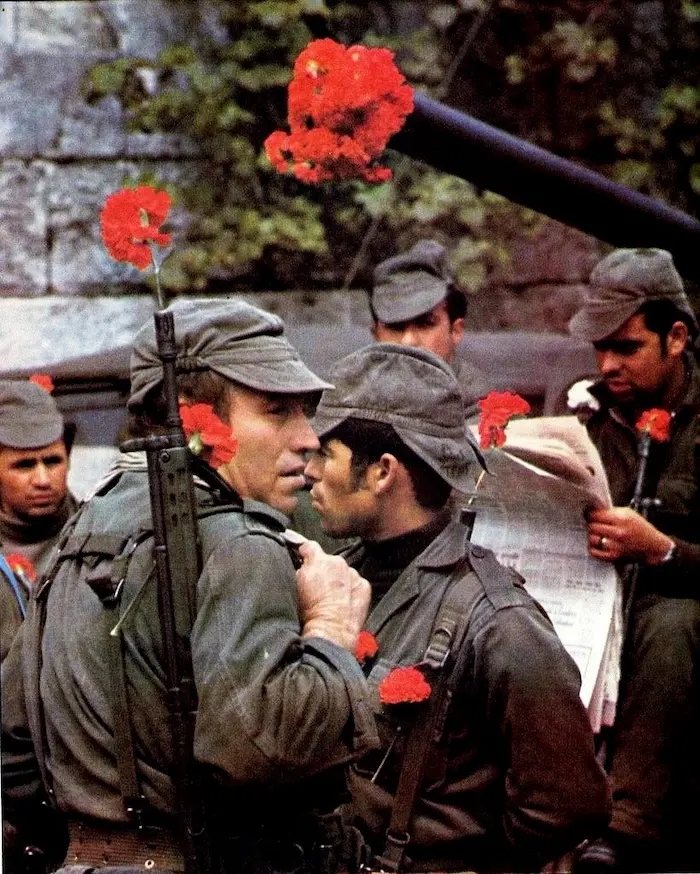
Members of the MFA took to the streets to overthrow the dictatorship, only to find the people, their comrades, marching alongside them, joining forces, and occupying public spaces and thoroughfares. Amidst all this, a young woman named Celeste Caeiro, left the restaurant where she worked with a basket full of carnations (the flower of the season) and en route to Rossio Square to catch the metro home, passed by a military post where a young soldier asked her for a cigarette. She didn't have any tobacco, and feeling nervous after searching, she decided to give him a red carnation, which the young man placed in the barrel of his rifle, indicating that it was a peaceful gesture. They chose to distribute the carnations among the other soldiers, and this act was considered the epitome of what was transpiring.

Woman putting the carnation on a soldier's rifle.
It was 9 a.m. on April 25th, and as the day unfolded, the streets continued to fill with flowers and embraces. In an emotional and spontaneous display, the populace placed carnations in the barrels of the rifles carried by the young freedom fighters, and many civilians hastened to accompany them toward the Carmo Barracks, where the prime minister was situated. Only the PIDE, which had been recently renamed by Marcelo Caetano as the General Directorate of Security (DGS), refused to accept defeat. At one point, when its headquarters on Antonio María Cardoso Street in Lisbon was surrounded by the people, the organization shamelessly fired upon them. Four deaths marred what had, until then, been a day of pacifist struggle. The headquarters was taken, and the DGS was officially dissolved on the same day. Prime Minister Marcelo Caetano surrendered at 5 p.m., as did President Américo Tomás, both of whom were allowed to leave the country and head to Brazil. General António de Spínola became the first president of Portugal after the revolution, leading the National Salvation Junta and advancing the transition towards democracy, freedom, and social and economic progress for the Portuguese people. This new parliamentary democracy also brought an end to the colonial wars and ensured the independence of Guinea-Bissau, Angola, Mozambique, Cape Verde, and São Tomé & Príncipe.
April 25th has since become a national holiday, dedicated to the memory of this revolutionary feat, prompting reflection on its origins, forms, and consequences, as a reminder to never forget that violence leads nowhere. This romantic aura still lingers fifty years later, a moment that captured the world's attention and admiration for the exemplary nature of the Portuguese experience.
You can enjoy this story and many others during our Main Free Tour of Porto.
.webp)